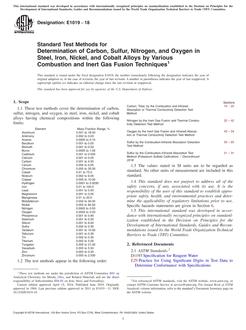
1.1 These test methods cover the determination of carbon, sulfur, nitrogen, and oxygen, in steel, iron, nickel, and cobalt alloys having chemical compositions within the following limits:
|
Element |
Mass Fraction Range, % |
|
Aluminum |
0.001 to 18.00 |
|
Antimony |
0.002 to 0.03 |
|
Arsenic |
0.0005 to 0.10 |
|
Beryllium |
0.001 to 0.05 |
|
Bismuth |
0.001 to 0.50 |
|
Boron |
0.0005 to 1.00 |
|
Cadmium |
0.001 to 0.005 |
|
Calcium |
0.001 to 0.05 |
|
Carbon |
0.001 to 4.50 |
|
Cerium |
0.005 to 0.05 |
|
Chromium |
0.005 to 35.00 |
|
Cobalt |
0.01 to 75.0 |
|
Niobium |
0.002 to 6.00 |
|
Copper |
0.005 to 10.00 |
|
Hydrogen |
0.0001 to 0.0030 |
|
Iron |
0.01 to 100.0 |
|
Lead |
0.001 to 0.50 |
|
Magnesium |
0.001 to 0.05 |
|
Manganese |
0.01 to 20.0 |
|
Molybdenum |
0.002 to 30.00 |
|
Nickel |
0.005 to 84.00 |
|
Nitrogen |
0.0005 to 0.50 |
|
Oxygen |
0.0005 to 0.03 |
|
Phosphorus |
0.001 to 0.90 |
|
Selenium |
0.001 to 0.50 |
|
Silicon |
0.001 to 6.00 |
|
Sulfur |
0.002 to 0.35 |
|
Tantalum |
0.001 to 10.00 |
|
Tellurium |
0.001 to 0.35 |
|
Tin |
0.002 to 0.35 |
|
Titanium |
0.002 to 5.00 |
|
Tungsten |
0.005 to 21.00 |
|
Vanadium |
0.005 to 5.50 |
|
Zinc |
0.005 to 0.20 |
|
Zirconium |
0.005 to 2.500 |
Product Details
- Published:
- 04/15/2018
- Number of Pages:
- 22
- File Size:
- 1 file , 360 KB
- Redline File Size:
- 2 files , 790 KB